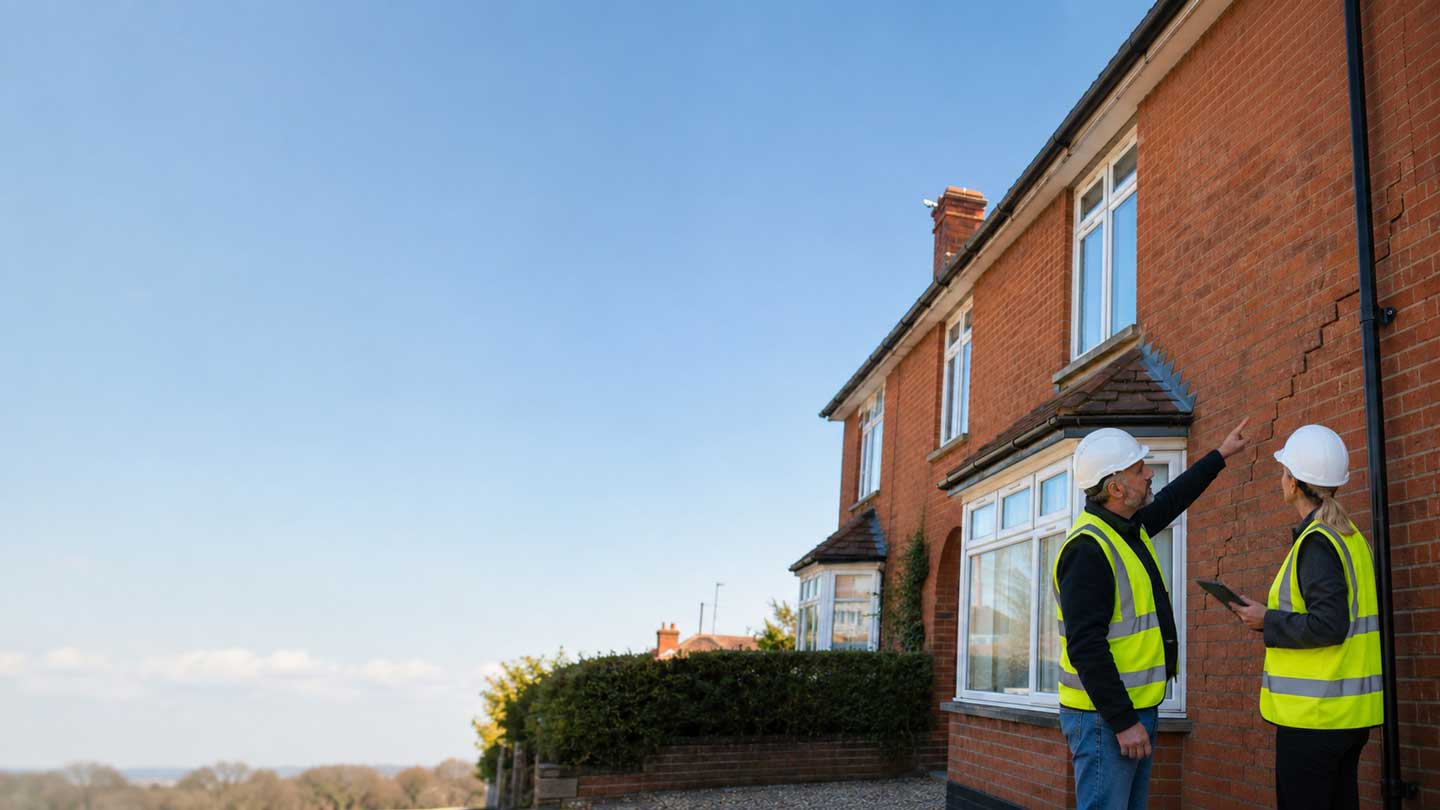
What does subsidence mean?
Subsidence is the downward movement of the ground beneath a building. When the ground supporting part of a property moves or loses strength, the foundations above it can move as well.
This movement is often uneven. One part of a building may move while another part remains relatively stable, which can place stress on walls, floors, openings and other parts of the structure.
Subsidence should not be confused with every type of cracking. Buildings can crack for many reasons, including normal settlement, temperature changes, shrinkage of materials, alterations and movement around doors and windows.
The important question is not simply whether a crack is present, but whether the building itself is moving and, if so, why.
What can subsidence do to a property?
Subsidence can produce a range of symptoms, depending on the amount and location of movement.
Possible signs include diagonal or stepped cracking, cracks around doors and windows, distortion of frames, sticking doors, uneven floors and gaps appearing where parts of the building meet.
In more serious cases, movement can affect masonry, foundations, structural openings and other parts of the building.
However, none of these signs on its own proves that subsidence is present. The pattern of movement matters. A crack that is changing, widening or appearing alongside other signs may be more significant than an old, stable crack that has remained unchanged for many years.
How does subsidence happen?
Subsidence can occur for several different reasons.
In some areas, shrinkable clay soil can lose moisture and contract during prolonged dry conditions. If this happens beneath foundations, part of a building may move downwards.
Trees and large shrubs can sometimes contribute by taking moisture from shrinkable soil, particularly where roots are close to a property.
Leaking drains or underground pipes can also affect the ground. Water may wash away fine material, soften the soil or create voids beneath or close to foundations.
Other possible causes include poorly compacted ground, old excavations, changes in groundwater, inadequate foundations or ground disturbed by previous building work.
Because there are several possible causes, it is dangerous to assume that every case of movement has the same explanation.
Finding the cause comes before repairing the damage
This is one of the most important points to understand about subsidence.
Cracks should not simply be repaired until the reason for the movement has been properly considered.
Filling cracks, repointing brickwork or replastering a wall may improve its appearance, but if the ground beneath the property is still moving, the damage may simply return.
The correct investigation depends on the circumstances. It may involve examining the pattern of cracking, checking whether movement is continuing, inspecting drainage, looking at nearby trees and considering the type of soil and foundations.
In some cases, cracks may need to be measured or monitored over a period of time before anyone can be confident that movement has stopped.
The aim should always be to understand the cause first and then choose a repair that deals with the actual problem rather than just its visible symptoms.
How might subsidence be fixed?
There is no single repair for subsidence because the correct solution depends on what is causing it.
If a leaking drain is responsible, repairing the drainage defect may be the most important step. If vegetation is contributing to movement in shrinkable soil, appropriate tree management may need to be considered.
Once the cause has been dealt with and the property is stable, repairs to the building itself can be considered.
Minor damage may involve filling cracks, repointing masonry or repairing plaster. More significant cracking may require structural reinforcement, such as crack stitching, or local rebuilding.
In some cases, foundations need strengthening. This may involve underpinning or another form of foundation stabilisation, but underpinning is not required in every case of subsidence.
The repair should match the cause and severity of the movement. Carrying out major structural work without first establishing why the movement occurred can be unnecessary, expensive and ineffective.
What should you do if you are worried about subsidence?
If you notice cracking or movement, start by looking at the overall pattern rather than one isolated sign.
Check whether cracks are new, whether they are changing, and whether doors, windows or floors are also being affected. Photographs and simple measurements can be useful if you need to monitor changes.
If the signs appear significant or movement seems to be continuing, consider obtaining advice from an appropriately qualified structural engineer or surveyor.
You can also use the Free Subsidence Check Tool to help you consider the signs you are seeing and decide what your next step might be.
The key point is simple: find out why the property is moving before deciding how to repair it.