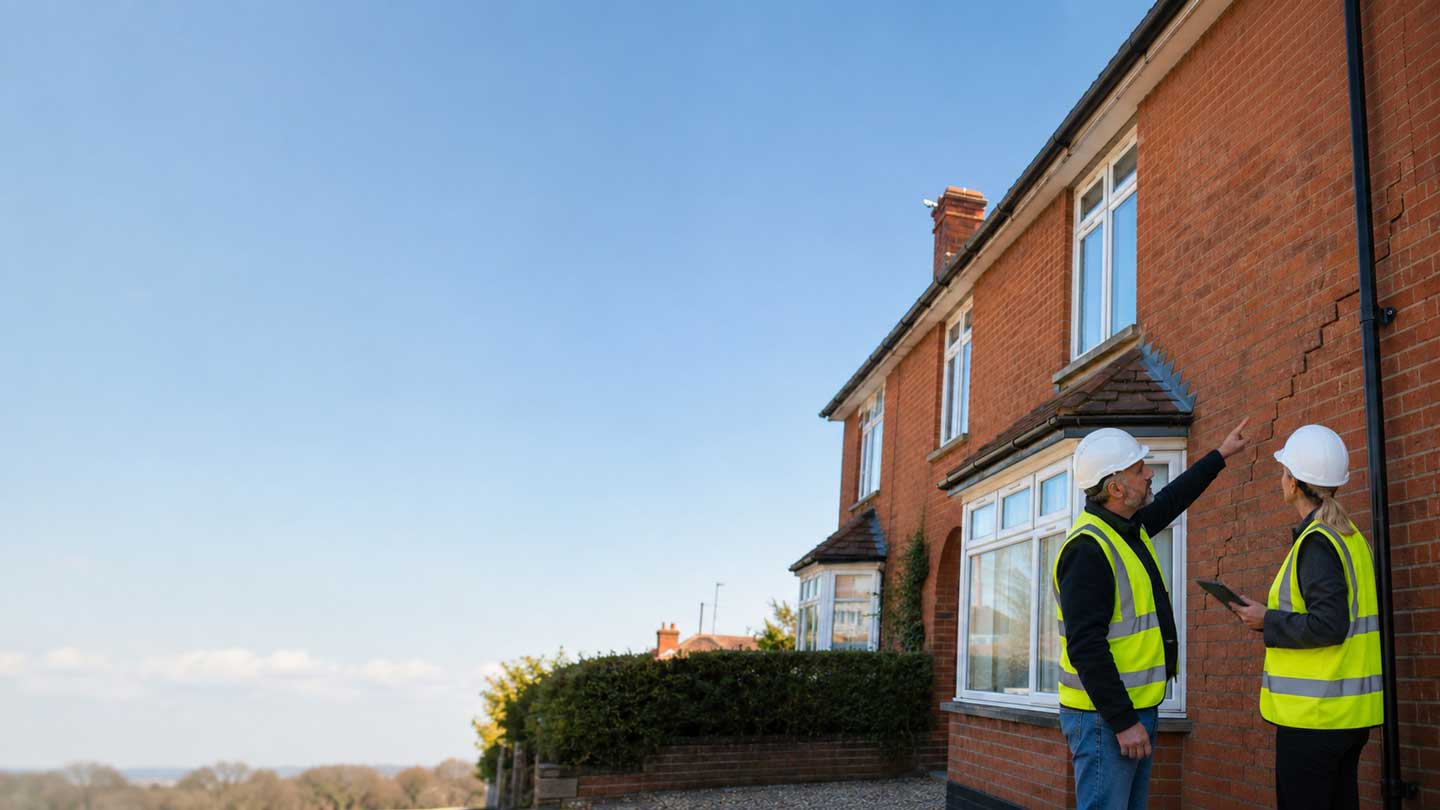
Why does subsidence happen?
Subsidence happens when the ground beneath part of a building moves downwards or loses some of its ability to support the foundations above it.
There is no single cause. The reason can vary from one property to another, depending on the type of soil, the age and depth of the foundations, nearby trees, drainage, previous building work and local ground conditions.
This is why it is important not to assume that visible cracking tells you what the cause is. Two properties can show similar cracks but have entirely different underlying problems.
Shrinkable clay soil
Clay soil is one of the better-known causes of subsidence in parts of the UK. Some clay soils change volume as their moisture content changes.
During prolonged dry conditions, the soil can lose moisture and shrink. If this happens beneath or close to foundations, the supporting ground may move downwards.
The movement is often uneven, which is why one part of a building may be affected more than another.
Clay-related movement can also be seasonal. A property may show greater movement during dry periods and less movement when the soil becomes wetter again.
Trees and large shrubs
Trees can contribute to subsidence where they are growing close to foundations in shrinkable clay soil.
Roots draw moisture from the ground. During dry weather, a large tree may increase moisture loss from clay soil, causing additional shrinkage close to the property.
The risk depends on several factors, including the species and size of the tree, its distance from the building, the soil type and the depth of the foundations.
A nearby tree does not automatically mean that it is causing the movement. Removing a tree without first establishing the cause can also create other problems, so significant tree work should not be treated as an automatic solution.
Leaking drains and underground pipes
Defective drains can sometimes affect the ground close to foundations.
Escaping water may soften certain soils, wash away fine particles or create small voids below ground. Over time, this can reduce the support beneath part of a building.
Drain problems can be particularly important where cracking is concentrated close to bathrooms, kitchens, soil pipes, inspection chambers or underground drainage runs.
A CCTV drain survey is sometimes used to look for broken joints, displaced pipes, cracks or collapsed sections.
Poor or disturbed ground
Subsidence can also occur where a building has been constructed on ground that was poorly compacted or previously disturbed.
Examples can include filled ground, old excavations, former pits, trenches or areas where soil has been replaced during earlier building work.
If the material beneath the foundations settles or compresses unevenly, parts of the property may move.
Ground conditions can also be affected by erosion, changes in groundwater or historic activity below the surface.
Foundation and construction problems
In some cases, the problem lies with the foundations themselves rather than a new change in the ground.
Older buildings may have relatively shallow foundations, while extensions and later alterations may have foundations of a different depth or design from the original structure.
Movement can sometimes appear where two parts of a building have been constructed differently or are reacting differently to the same ground conditions.
Poorly designed, inadequate or damaged foundations can also contribute to structural movement.
Whatever the suspected cause, it is essential to establish it as accurately as possible before repairs begin. Filling cracks or strengthening walls without dealing with the underlying reason for the movement may only hide the problem temporarily.
The correct treatment starts with the correct diagnosis of the cause.