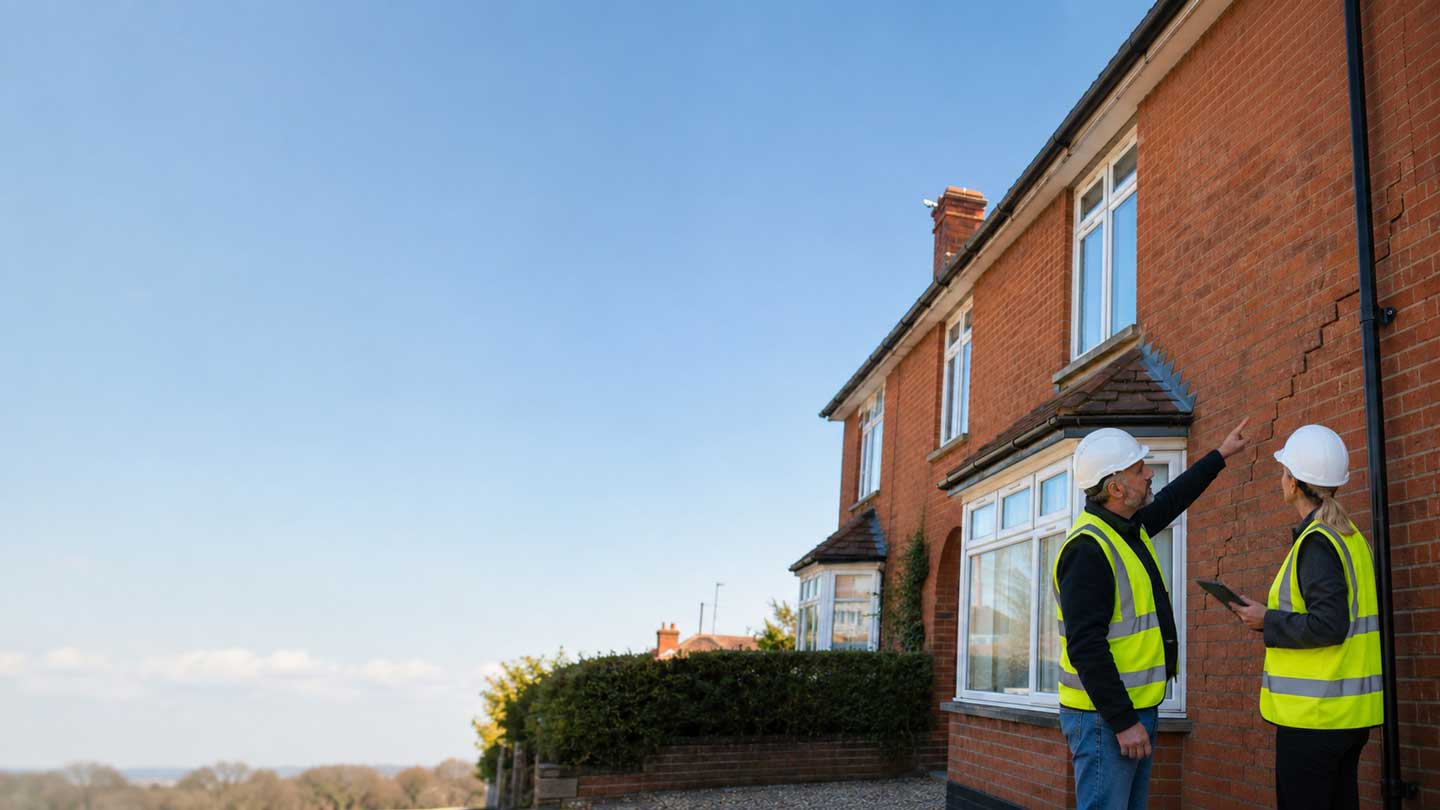
Finding the cause must come first
There is no single treatment for subsidence. The correct repair depends entirely on why the building has moved.
This is why the most important step is to establish the cause before any treatment begins.
A cracked wall may be the visible result of movement, but filling the crack does nothing to solve a leaking drain, shrinking clay soil, tree-related movement or a problem with the foundations.
Treating the damage before understanding the cause can waste money and may allow the movement to continue.
In some cases, investigation may involve drainage checks, monitoring cracks, examining nearby trees, considering soil conditions or obtaining advice from a structural engineer or surveyor.
Repairing leaking drains and underground pipes
Defective drains can contribute to subsidence by allowing water to escape into the surrounding ground.
Depending on the soil, leaking water may soften the ground, wash away fine material or create localised voids close to foundations.
If a drain is found to be the cause, repairing or replacing the damaged section may remove the source of the movement.
A CCTV drain survey is sometimes used to identify broken joints, collapsed sections or other defects.
Once the drainage problem has been repaired, the building may need to be monitored before cosmetic or structural repairs are completed.
Tree and vegetation management
Trees and large shrubs can sometimes contribute to subsidence where foundations are built on shrinkable clay soil.
Their roots take moisture from the ground and, during dry conditions, this can increase soil shrinkage around the foundations.
If vegetation is suspected, the solution may involve pruning, managing or, in some cases, removing a tree.
Tree removal should not be treated as an automatic solution. The type, size and distance of the tree, the soil conditions, foundations and any relevant legal restrictions all need to be considered.
In some circumstances, removing a mature tree from clay soil can introduce other movement as the ground gradually takes up moisture again.
For this reason, professional advice may be needed before significant tree work is carried out.
Monitoring the movement
Sometimes the most appropriate first action is to monitor the property rather than immediately carry out structural work.
Crack widths can be measured over time to establish whether movement is continuing, slowing or has stopped.
Photographs taken from the same position can also provide a useful record. In more serious cases, formal monitoring equipment may be used.
Monitoring can be especially valuable where the cause is uncertain or where the suspected problem is seasonal, such as movement associated with clay soils.
It can help prevent unnecessary repairs being carried out before anyone knows whether the building is still moving.
Repairing cracks and damaged masonry
Once the cause has been dealt with and the building is considered stable, repairs to the damage can begin.
Minor cracks may only need filling, repointing or local plaster repairs. More significant cracking may require damaged masonry to be rebuilt.
Crack stitching is another possible repair. This usually involves installing metal reinforcement across a crack to help restore strength and distribute loads through the masonry.
These methods repair the structure, but they should not be confused with correcting the original cause of subsidence.
If the ground is still moving, even a well-repaired crack may eventually open again.
Foundation strengthening and underpinning
Where movement is more serious and the foundations cannot be stabilised by dealing with the underlying cause alone, additional foundation support may be considered.
Underpinning is one method. It involves strengthening or extending the existing foundations so that they are supported by more suitable ground.
Other modern foundation-stabilisation methods may also be appropriate, depending on the property, ground conditions and extent of movement.
Underpinning is not required for every case of subsidence and should not be seen as the standard treatment.
It can be expensive and disruptive, so it should normally only be considered where investigation shows that it is genuinely necessary.
The key principle remains the same: establish the cause first, stabilise the source of the movement, and only then decide what structural repairs are appropriate.